
Precast Column Detailing Services USA | ACI/PCI Compliant Shop Drawings
Get precision precast column detailing services in the USA with ACI/PCI compliant shop drawings, LOD 400 BIM, and Tekla/Revit modeling to reduce RFIs and delays.
Our precast column detailing services cover the full lifecycle — from conceptual models through fabrication-ready shop drawings — for single- and multi-story column grids across commercial, industrial, and infrastructure projects in the USA. Working in Tekla Structures and Autodesk Revit at LOD 350–400, we model each precast column with accurate geometry, reinforcement, connection hardware, and camber or corbel conditions to match engineer-of-record intent and fabricator preferences. The result: coordinated marking plans, piece tickets, and erection drawings that reduce RFIs, field fixes, and downstream schedule risk.
Precast column detailing is the discipline that bridges the gap between the structural engineer’s load path design and the precasting plant’s production floor — ensuring every embedment plate, reinforcement bar, lifting insert, and connection interface is precisely positioned, dimensioned, and clash-free before a single yard of concrete is poured. For US-based contractors, engineers, and precast fabricators, we deliver a single source of truth that streamlines the transition from the fabrication plant to the construction site.
Stop Project Delays Caused by Incomplete Precast Column Details
Incomplete or poorly coordinated precast column details are one of the most avoidable sources of schedule risk on US construction projects. Understanding where the problems start is the first step to eliminating them.
The Cost of Late RFIs, Rework, and Site Fixes
When precast column drawings go to the fabrication plant without resolving reinforcement congestion, connection misalignments, or embed conflicts, the consequences are measurable: production holds while RFIs are resolved, field crews wait for corrected shop tickets, and erection sequences shift — compressing downstream trades and inflating change order costs. Late-stage corrections to column-to-beam interfaces or base plate anchor patterns are among the most expensive field fixes in precast construction.
- Reinforcement congestion at column heads and bases — Insufficient clear cover or overlapping bar zones that prevent proper concrete consolidation and create pour defects
- Misaligned connection interfaces — Grouted sleeve locations, embedded plate positions, or corbel geometry that don't match the structural drawings or the adjacent precast elements
- Fabrication tolerance conflicts — Column dimensions or hardware positions that are technically correct per design but fall outside PCI plant fabrication tolerances, forcing costly re-work
- Erection sequence gaps — Shop drawings that omit or ambiguously document lifting insert layouts, temporary bracing requirements, or erection tolerances — creating field guesswork during installation
Every one of these issues is detectable and resolvable in a properly constructed LOD 400 BIM model before a single shop ticket is issued. Our QA/QC workflow is built specifically to catch them.
Our Precast Column Detailing Scope
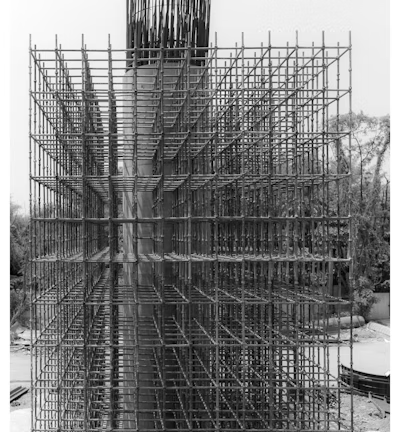
Precast Column Shop Drawings & Detailing
Our detailing process is rooted in a deep understanding of PCI (Precast/Prestressed Concrete Institute) and ACI 318-25 standards. We provide comprehensive reinforcement detailing that accounts for complex load paths and seismic requirements:
- Vertical bar sizing, spacing, and confinement tie schedules
- Seismic special column detailing per ACI 318-25 Chapter 18
- Corbel and ledge reinforcement with ACI 318-25 strut-and-tie compliance
- Spiral column cage detailing with pitch and cover verification
- Bar bending schedules generated directly from the model for steel procurement and bending
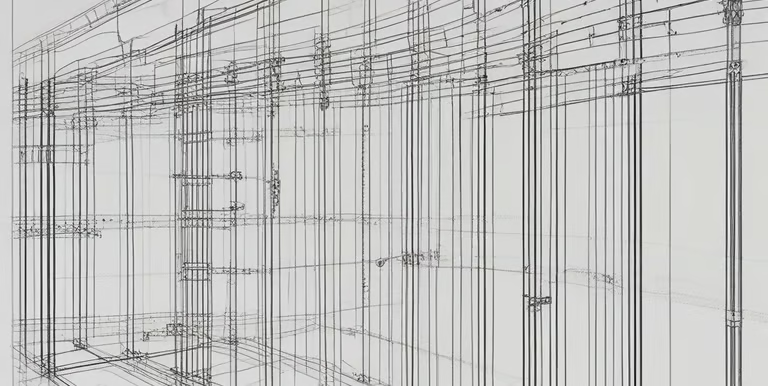
Precast Connection Detailing & Embedded Hardware Layouts
At the core of our service is constructability. We proactively resolve reinforcement congestion at column heads, bases, and connection zones, and validate clear cover, lap lengths, and development lengths against ACI and PCI requirements before drawings are issued for approval. Our precast connection detailing covers:
- Corbels — with embedded bearing plates and vertical stirrups
- Base plate connections — anchor bolt patterns, grout pad details, and column-to-footing interfaces
- Column-to-beam interfaces — grouted sleeves, pocket connections, welded plate assemblies, and moment or shear connections
- Embedded plates and headed studs — positioned and scheduled for structural performance and lift-point loads
- Tolerances and erection sequences — clearly documented on shop drawings and installation details
LOD 350–400 BIM Modeling for Coordination & Clash Detection
Our precast column detailing services are fully integrated into the BIM ecosystem. We utilize automated clash detection to identify reinforcement congestion and embedment conflicts long before the first yard of concrete is poured.
LOD 400 Tekla / Revit Modeling
Every reinforcing bar, embed plate, and lifting device is modeled individually with its actual geometry, grade, and fabrication properties — including camber, corbel conditions, and connection hardware.
Internal Clash Detection
Conflicts between bars, embedded plates, anchor bolts, sleeves, and hardware are identified and resolved within the column model before federation. Clear cover and spacing are validated against ACI 318-25 requirements.
Automated Ticket & BBS Generation
The model auto-generates piece tickets, bar bending schedules, and hardware schedules without manual re-entry, and exports IFC 4 files for federated coordination across structural, architectural, and MEP trades.
Navisworks Federated Clash Run
All precast column models are clash-tested against structural steel framing, MEP rough-in, and adjacent precast elements. Clash reports are issued with specific element IDs and location references for rapid EOR resolution.
LOD 350 vs LOD 400 for Precast Columns
LOD 350 — Columns modeled with accurate size, location, and connection interfaces for clash detection and erection coordination. Suitable for layout planning and trade coordination with sufficient detail for interface design across disciplines.
LOD 400 — Fabrication-level detail including full reinforcement, embedded plates, connection hardware, lifting inserts, and construction tolerances. Shop drawings, bar bending schedules, piece tickets, and CNC exports derived directly from the model ensure what is detailed is exactly what is fabricated and erected.
Technical Excellence: Software, Standards, and Workflows
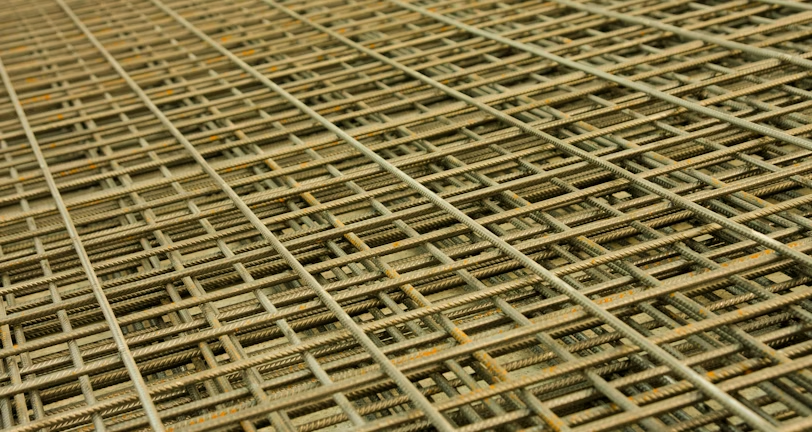
Tekla & Revit-Driven Precast Column Models
We work natively in Tekla Structures and Autodesk Revit 2026 — the platforms that US precast fabricators and structural engineers trust for production-level BIM modeling. Our modelers are experienced with both platforms, allowing us to align with your existing project environment:
- Tekla Structures — preferred for complex reinforcement and piece mark management, automated shop ticket generation, and CNC/robotic exports to precast plant equipment
- Autodesk Revit — used where project coordination requires a Revit-centric BIM environment, with full rebar modeling and IFC 4 federated exports
- AutoCAD & Bluebeam Revu — for 2D drawing production, markup review, and submittal management
ACI, PCI, and Project-Specific Standard Compliance
Every precast column detail we produce is cross-referenced against applicable standards before submittal. Our QA checklist covers the provisions most likely to generate RFIs or shop drawing rejection:
- ACI 318-25 — bar sizes, spacing, cover, development lengths, lap lengths, and seismic special column provisions (Chapter 18)
- PCI MNL-116 — fabrication quality control requirements and plant production tolerances
- ASTM A615 / A706 — deformed reinforcing bar material and grade specifications
- AISC 360 — for embedded steel plate connection components and bearing hardware
Applications & Sectors We Support
Our precast column detailing expertise spans the full range of US construction sector types — from repetitive parking structure grids to complex industrial frames.
- High-Rise Commercial Frameworks — Column-to-beam moment connection zones in office and residential towers; multi-story column grids coordinated with precast beam and hollowcore floor systems
- Parking Structures — Repetitive column cages with consistent embedment patterns for lean production; spandrel and inverted tee coordination at column heads
- Industrial Facilities & Data Centers — Heavy corbel and crane bracket detailing for manufacturing and distribution centers; data center structures requiring high positional accuracy for mechanical and electrical coordination
- Accelerated Bridge Construction (ABC) — Precast pier columns with grouted splice sleeve connections; abutment columns and bent cap interfaces per AASHTO LRFD requirements
- Mid-Rise Residential & Mixed-Use — Multi-family and podium structures with repeating precast column grids; coordinated with precast beam, double-tee, and hollowcore systems
Why Contractors and Engineers Choose Us
US-based general contractors, precast fabricators, and structural engineers partner with us for one reason: drawings that work the first time.
- Manufacturing-ready shop drawings aligned to ACI and PCI requirements — Proven expertise delivering precast column piece tickets and bar bending schedules that PCI-certified plants can take directly into production without reinterpretation
- BIM-driven coordination at LOD 400 — Tekla Structures and Revit workflows that provide accurate clash detection and coordination across structural, architectural, and MEP trades before any concrete is poured
- Robust multi-stage QA/QC process — Dedicated review checkpoints for bar schedules, connection details, and embedded hardware to reduce RFIs, change orders, and field rework on your project
- Proven US project experience — Supporting precast fabricators and contractors on parking structures, industrial facilities, data centers, and multi-story commercial and residential buildings
- Flexible engagement models — Scalable capacity that compresses your schedule during peak bid or production periods while maintaining consistent drawing standards, title blocks, and documentation across every project
Deliverables
Shop Tickets (Piece Drawings)
Bar Bending Schedules
3D Tekla / Revit Model
Clash Detection Report
Erection Drawings & GA Plans
Hardware & Lifting Insert Layouts
Material Take-Offs
Standards & Compliance
Software & Tools
Frequently Asked Questions — Precast Column Detailing
Technical answers to common questions about precast column shop drawings, ACI/PCI compliance, BIM modeling, and project workflows for US structural teams and precast fabricators.
Supporting Insights
Related Technical Reads
Precast Detailing
Precast vs. Cast-in-Place Concrete: Which is Right for Your Project?
A comprehensive comparison of precast and cast-in-place concrete — weighing cost, quality control, schedule, and detailing requirements for your next build.
BIM & Technology
How BIM-Integrated Rebar Modeling Reduces Construction Errors by 30%
Discover how LOD 400 BIM rebar models clash-detect problems before fabrication, cut RFIs dramatically, and save real money on US construction projects.