
Precast Beam Detailing Services USA
PCI/AASHTO-compliant precast beam detailing for US projects. Shop drawings, rebar detailing, bar bending schedules, and BIM LOD 300–400 — fast, coordinated delivery for fabricators and erectors.
Get production-ready precast beam shop drawings that align with PCI, ACI 318, AASHTO LRFD, and AISC requirements for US projects. Every beam is modeled and detailed for constructability, coordinated with the surrounding structure, and checked through a documented QA process — delivering accuracy from the first shop ticket to the final erection package.
Our precast beam detailing services cover the full scope of fabrication documentation: piece drawings, erection drawings, reinforcement detailing, bar bending schedules, and LOD 300–400 BIM models in Tekla Structures or Revit. Whether your project calls for standard rectangular beams in a commercial frame, inverted tee bridge girders per AASHTO LRFD, or complex spandrel and raker profiles for a stadium or parking structure, we deliver drawings that fabricators, PCI-certified plants, and erectors can trust.
Beam Types We Detail
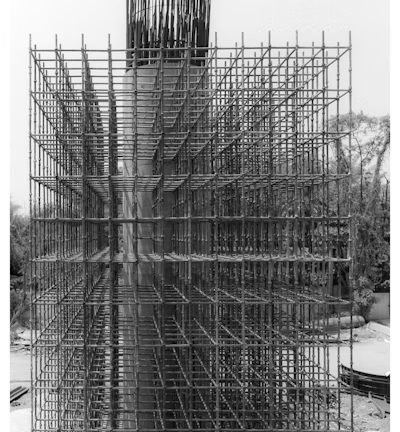
Rectangular & L-Beams
Standard rectangular and L-beam profiles for commercial building frames, parking structures, and industrial facilities. Our shop tickets include all stirrup and torsion tie spacing, cover dimensions, shear key geometry, lifting point layouts, and connection hardware — everything a PCI-certified plant needs to go straight into production.
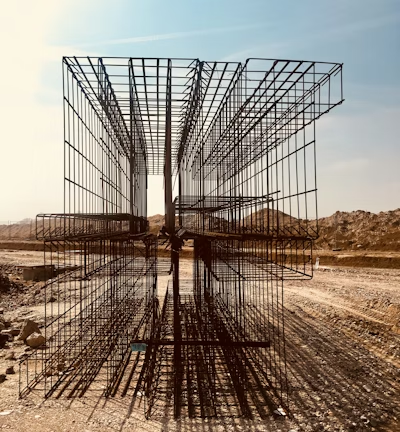
Inverted Tee (IT) Beams & Raker Beams
Inverted Tee Beams: The most common bridge beam profile for US highway bridges. We detail flange and web reinforcement, prestress strand layouts, bearing seat geometry, diaphragm pockets, and shear keys per AASHTO LRFD and state DOT standards — formatted to FDOT, TxDOT, Caltrans, and other state DOT submittal requirements.
Raker Beams: Raked and angled beams for stadium seating, multi-level parking ramps, and grandstand structures. We resolve the complex skew geometry in 3D before shop tickets are issued, eliminating costly field corrections during erection.
Spandrel & Ledge Beams: Perimeter spandrels and ledge-bearing beams for precast frames. We coordinate notch geometry, embed pockets, cladding attachments, and bearing details with adjacent double-tee or hollowcore members.
Precast Beam Shop Drawings
Accurate precast beam shop drawings are the foundation of reliable production, erection, and long-term performance. Every drawing set we issue is coordinated, standards-checked, and fabrication-ready.
- Piece drawings (shop tickets) — plan, elevation, and section views with all critical dimensions, concrete strength, reinforcement grades, camber, and identification marks
- Erection drawings — setting plans aligned with project gridlines and levels, bearing and haunch details, piece sequencing, and PCI MNL-127-compliant callouts
- Connection details — bearing pads, corbels, embedded plates, anchor bolts, and moment connection hardware drawn to project specifications
- Lifting and handling details — lifting point locations, insert schedules, and temporary bracing notes to support plant handling and site erection
- Dimensional control and clash avoidance — every drawing is checked against contract documents, PCI design recommendations, and project-specific tolerances before issue
Shop drawings are produced from coordinated 3D models or carefully reviewed 2D design inputs. Typical deliverables include beam piece tickets, erection drawings, connection details, and setting plans — all checked against ACI and AASHTO provisions to help reduce RFIs, change orders, and site rework.
Rebar Detailing, Bar Bending Schedules & BOM for Precast Beams
Reinforcement in precast beams must satisfy both design strength requirements and plant fabrication constraints. Our reinforcement packages are built to match the workflows of US precast plants and rebar fabricators.
- Complete rebar layouts — bar sizes, spacing, cover, development and lap lengths, stirrup patterns, shear reinforcement, and confinement steel around openings and bearing zones
- Bar bending schedules (BBS) — generated directly from the model, with clear bar marks, bending shapes, lengths, and quantities to streamline cutting and bending at the rebar fabrication shop
- Bills of materials (BOM) — quantity take-offs summarizing reinforcing steel, embeds, plates, anchors, and hardware per beam and per pour sequence
- Prestress strand layouts — for pretensioned beams, strand patterns, debonding lengths, and force calculations documented on shop tickets per AASHTO LRFD and PCI requirements
- PCI quality-procedure alignment — schedules and BOMs organized to support plant quality control, purchasing, inventory management, and production planning
Bar bending schedules are formatted to ACI 315 conventions and cross-referenced to beam piece tickets so plant personnel can quickly verify reinforcement against the correct drawing.
3D BIM Modeling for Precast Beams (LOD 300–400)
Our bridge-specific engineering relies on tight clash coordination between all structural and MEP trades. We run federated models through Navisworks before any shop ticket is finalised.
Model Established
Project coordinate reference system established and LOD 400 Beam Model built in Tekla Structures or Revit — full reinforcement, embeds, camber, and hardware modeled at fabrication-ready detail.
Internal Clash Check
Rebar clearance verified against ACI 318-25 §26.4.2 minimum spacing. Embed clearances and hardware conflicts resolved within the beam model before federation.
Federated Clash Run
Navisworks clash detection run against structural steel, MEP, architectural, and other precast elements. Issues logged and resolved digitally before they reach the plant or site.
Final Shop Ticket Issue
Revisions incorporated after EOR and precaster review. Fabrication-ready package released — shop drawings, erection drawings, BBS, BOM, and CNC/robotic exports all generated directly from the model.
LOD 300 vs LOD 400 for Precast Beams
LOD 300 — Members modeled with accurate size, location, and structural relationships for clash detection and erection coordination. Suitable for layout planning and trade coordination.
LOD 400 — Fabrication-level detail including reinforcement, embeds, connection plates, lifting devices, camber, and construction tolerances. Shop drawings, BBS, and CNC exports derived directly from the model ensure what is detailed is exactly what is fabricated and erected.
AASHTO Bridge Beam Detailing
Our bridge-specific detailing workflow follows the latest AASHTO LRFD Bridge Design Specifications (9th Edition). We specialize in delivering accurate, submission-ready packages for every major US DOT authority.
- Inverted Tee and Raker beam profiles with accurate tendon profiles and prestress force calculations
- Diaphragm and continuity connection details for multi-span bridges
- DOT submittal packages — formatted to meet individual state department of transportation requirements (FDOT, TxDOT, Caltrans, and others)
- As-built drawing reconciliation following field measurement surveys
- Shear key, bearing seat, and haunch details coordinated with superstructure geometry and bridge deck elements
When bridge beam profiles deviate from standard precast plant forms, we model the custom geometry in Tekla to verify formwork dimensions before fabrication tooling is committed.
Industries & Project Types
Precast beam and column detailing services for every major US construction sector — from highway bridges to high-rise commercial frames.
Bridge & DOT Projects
Bridge girders, bent caps, and abutment beams for state and federal highway projects. We follow AASHTO LRFD requirements and individual DOT standards to produce submission-ready precast beam detailing packages. Our teams have supported projects under FDOT, TxDOT, Caltrans, and NCDOT requirements.
Parking Structures & Stadiums
Spandrel beams, inverted tees, raker beams, and ledge-bearing profiles for multi-level parking decks, stadium seating tiers, and grandstand structures. Complex skew geometry and variable rake angles are resolved in 3D before shop tickets are issued, keeping erection on schedule and reducing field RFIs.
- Industrial facilities — heavy-bay warehouse frames, precast loading dock beams, and crane girder supports
- Commercial construction — office building and retail frame beams coordinated with hollowcore and double-tee floor systems
- Residential and mixed-use — precast beam and column frames for multi-family mid-rise and podium structures
- Infrastructure and transit — transit platform beams, utility corridor headers, and precast culvert systems
Clash Detection & BIM Coordination Workflow
Model-based coordination eliminates design conflicts before they reach the fabrication plant or job site. Every precast beam package is clash-checked in a federated model environment.
- Federated model coordination — beam models combined with structural, architectural, MEP, and other precast elements for comprehensive clash detection in Navisworks
- RFI reduction — issues resolved digitally before fabrication, reducing costly field changes, rework, and pour cycle delays
- Coordination with bearing and connection elements — embed locations, corbel geometry, and bearing details cross-checked against adjacent structural members
- BIM deliverables — IFC 4 exports, coordination reports, clash logs, and model files shared in formats compatible with your project BIM workflow
Coordinated precast beam models support downstream workflows including erection sequencing, quantity take-offs, and PCI plant scheduling — turning the 3D model into a project-wide coordination asset.
Deliverables
Shop Tickets
Erection Drawings
Bar Bending Schedules
3D Tekla/Revit Model
Clash Report
Material Take-Offs & BOM
Standards & Compliance
Software & Tools
Frequently Asked Questions — Precast Beam Detailing
Technical answers to common questions about precast beam shop drawings, standards compliance, BIM modeling, and project workflows for US structural and precast teams.
Supporting Insights
Related Technical Reads
Precast Detailing
Precast vs. Cast-in-Place Concrete: Which is Right for Your Project?
A comprehensive comparison of precast and cast-in-place concrete — weighing cost, quality control, schedule, and detailing requirements for your next build.
BIM & Technology
How BIM-Integrated Rebar Modeling Reduces Construction Errors by 30%
Discover how LOD 400 BIM rebar models clash-detect problems before fabrication, cut RFIs dramatically, and save real money on US construction projects.