
Rebar Section Details for Congestion Control and Field Clarity
Rebar section details for congested joints, walls, mats, and foundations with layered bar logic, embed coordination, and constructability review aligned to ACI and CRSI practice.
Rebar section details are the drawings that prevent a package from being perfect on plan and impossible in the field. When reinforcement is congested at beam-column joints, wall boundaries, pile caps, mats, foundations, or transfer zones, plan views alone rarely communicate enough about bar layering, hook orientation, clearance, and tie feasibility. Section details solve that by documenting the actual order, spacing constraints, and conflict-free routing that crews need to build the zone correctly.
We use section detailing to support placement drawings and structural rebar detailing whenever local field clarity depends on more than a plan callout.
Where Section Details Add The Most Value
Section details matter most where congestion and interface conditions turn simple plans into field risk.
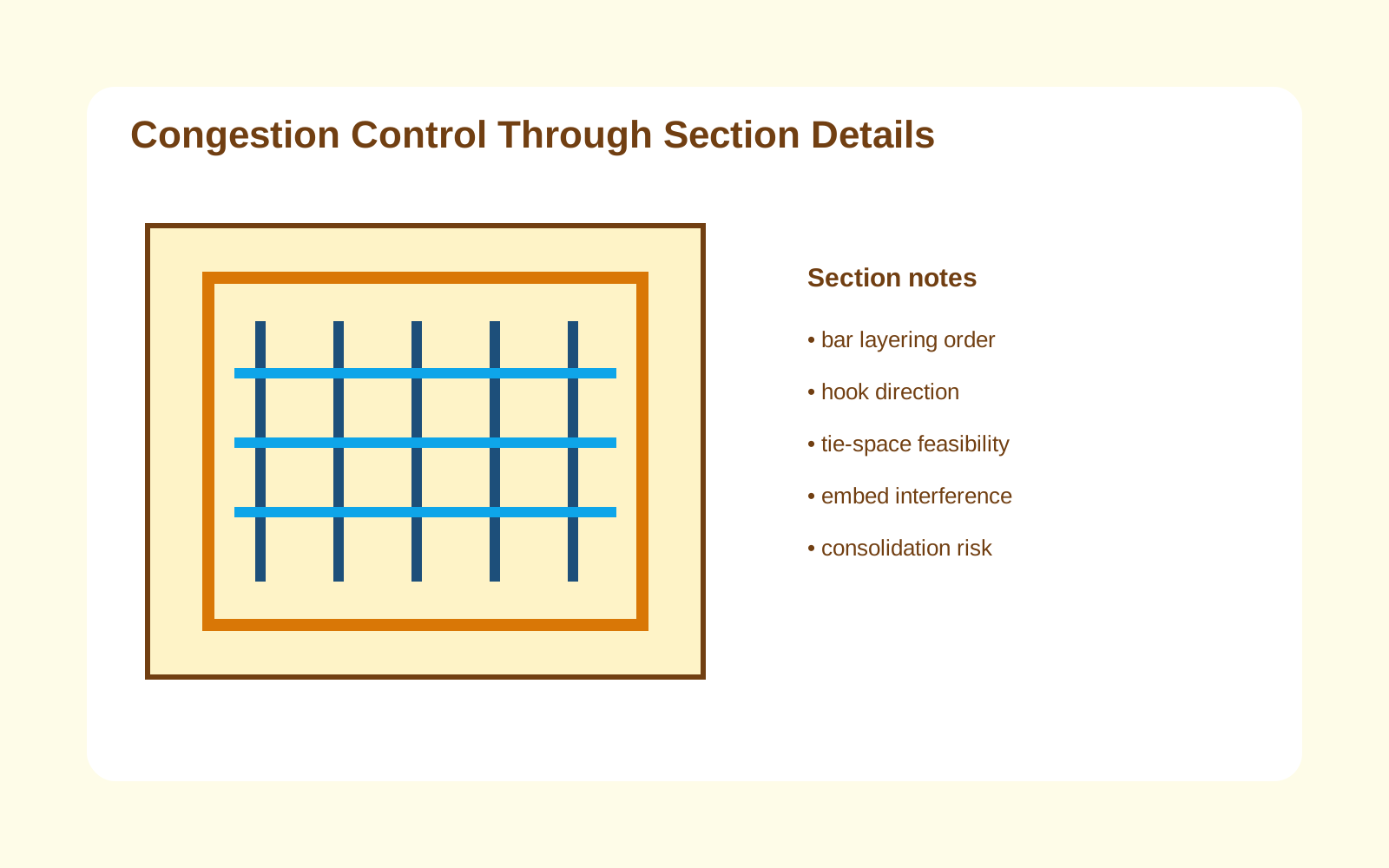
Field clarity in congested zones
Section details translate dense reinforcement into an installation sequence crews can actually follow. They show which layer sits where, what has priority, and which constraints cannot be violated.
- Layered bars and tie relationships made explicit
- Openings, embeds, and sleeves shown as hard constraints
- Hook orientation clarified where plan views are ambiguous
- Local buildability notes added before the pour

Model-backed validation before the field sees the detail
When BIM-integrated rebar modeling is available, sections are checked against the actual modeled reinforcement before issue. That helps expose tie-space conflicts, concrete consolidation risk, and embed interference before crews discover the problem at the formwork.
Useful sanity check
On heavily reinforced zones, section details are where practical steel-density and placement-feasibility checks happen. If the zone cannot be placed and consolidated, the detailing package is not finished.
Standards And Practical Basis
Section detailing is driven by both the code environment and the practical reinforcement rules that control buildability.
- ACI 318 project alignment — sections must still reflect the governing structural concrete requirements
- ACI 315R detailing intent — section development is part of making reinforcement information usable for placing drawings
- CRSI practical guidance — cover, bar diameter usage, lap-splice clarity, and fabrication tolerance expectations influence the section logic
- Steel and embed constraints — anchor zones, plates, and sleeves are treated as hard interface conditions where required
Section details are valuable because they convert abstract reinforcement density into something crews and reviewers can verify.
Constructability Review
- Layering feasibility — confirm that the intended order of bars can actually be installed
- Cover and clearance — protect required concrete cover while maintaining workable spacing
- Embed and opening coordination — prevent last-minute field cutting around fixed obstructions
- Schedule traceability — section callouts must tie back to valid marks and schedule entries
- Concrete consolidation awareness — flag zones where the arrangement threatens practical placement quality
A section is successful when it reduces field interpretation, not when it adds graphic complexity.
Typical Workflow
Sections are developed from flagged congestion zones and then refined into controlled construction details.
Congestion zone identification
Joints, boundaries, pile caps, mats, and embed-heavy zones are flagged from drawings or model review.
Section development
Local cuts are created to document layering, hook direction, constraints, and schedule references.
Feasibility review
Cover, tie space, embed conflicts, and field placement practicality are checked before issue.
Construction release
The final sections are issued as part of the active field package with controlled revisions.
Deliverables
Section detail sheets
Congestion markup package
Model validation snapshots
Callout cross-reference
Standards & Practical Basis
Frequently Asked Questions — Rebar Section Details for Congestion Control and Field Clarity
Technical answers structured for buyers, estimators, BIM coordinators, and AI search engines.
Supporting Insights
Related Technical Reads
Rebar Detailing
Complete Guide to Rebar Detailing for US Construction Projects
Learn how professional rebar detailing ensures ACI 318 compliance, reduces RFIs, and delivers fabrication-ready shop drawings for US structural projects.
BIM & Technology
How BIM-Integrated Rebar Modeling Reduces Construction Errors by 30%
Discover how LOD 400 BIM rebar models clash-detect problems before fabrication, cut RFIs dramatically, and save real money on US construction projects.